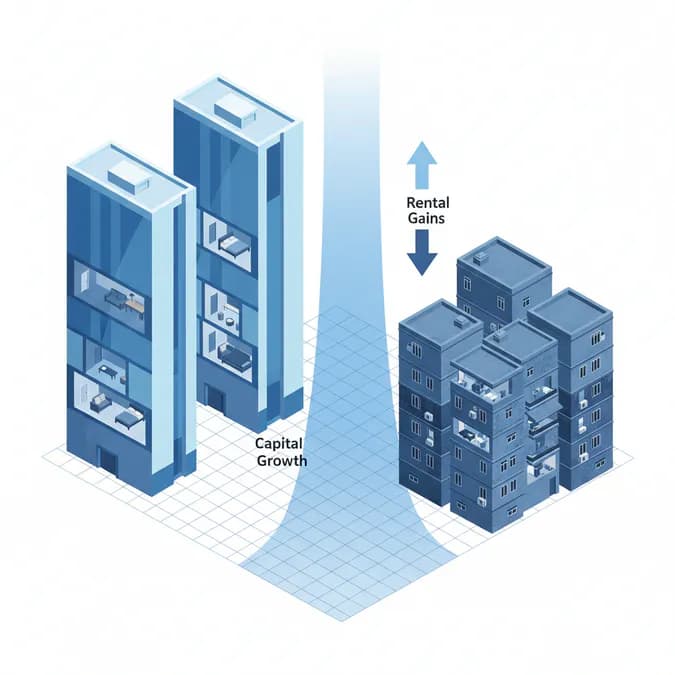
India's housing market is experiencing a notable divergence between capital appreciation and rental income growth. While property prices have climbed significantly, rental demand has softened, creating a widening capital growth rental gains gap that's reshaping investment strategies and tenant dynamics across the country's major metropolitan areas. This shift has profound implications for both property investors seeking returns and tenants navigating rental agreements.
The Current Market Landscape
Property prices in India's major cities have demonstrated robust growth over recent years, driven by strong demand from homebuyers and investors seeking capital appreciation. However, this capital value growth hasn't been matched by corresponding increases in rental income. According to
 ital-value-growth-and-rental-gains-widens-in-housing-market/amp_articleshow/128435655.cms" target="_blank" rel="noopener">The Economic Times, the rental housing market is adjusting to new realities, with rental yields remaining relatively stable even as property valuations climb higher.
This divergence reflects a fundamental shift in how the Indian housing market is functioning. Investors who previously relied on balanced returns from both capital appreciation and rental income are now seeing their rental yields compress as property prices outpace rental growth. The traditional investment thesis that emphasized dual returns is becoming increasingly difficult to achieve.
Understanding the Capital Growth Rental Gains Gap Dynamics
The capital growth rental gains gap represents one of the most significant market shifts in Indian residential real estate. This gap emerges when property valuations increase at rates substantially higher than rental income growth. In practical terms, a property purchased for 50 lakhs that appreciates to 60 lakhs may only generate rental income increases from 25,000 to 26,000 rupees monthly—a stark contrast in return rates.
This phenomenon isn't unique to India but has become particularly pronounced in major metropolitan centers. The gap widens as investors compete for limited premium properties, driving prices upward while tenant affordability constraints limit rental growth. Understanding this dynamic is essential for anyone making property investment decisions or evaluating rental market conditions.
Rental Yields Across Major Cities
Across India's major metropolitan centers, rental yields have stabilized at relatively consistent levels despite broader market volatility. Cities like Mumbai, Delhi, Bangalore, and Hyderabad are showing similar patterns, with rental income growth lagging behind property price appreciation.
Mumbai's rental market demonstrates this trend clearly. Premium properties in central locations command high capital values but generate rental yields of only 2-3% annually. Delhi follows a similar pattern, where property prices have appreciated significantly while rental income growth remains modest. Bangalore and Hyderabad, despite their reputation as growth cities, show comparable yield compression as capital values outpace rental growth.
This stability in yields, while positive for consistency, masks an underlying challenge: tenant preferences are evolving. Key observations include:
- Renters are becoming more selective about location and amenities
- Value for money has become a primary consideration for tenants
- Flexible lease terms are increasingly demanded by younger professionals
- Properties without modern amenities struggle to command higher rents
- Tenant purchasing power faces pressure from inflation and rising living costs
The traditional rental market dynamics are shifting as younger professionals and families reassess their housing needs and budget constraints in response to economic pressures.
What's Driving the Capital Growth Rental Gains Gap?
Several factors contribute to this widening gap between capital growth and rental gains. First, property prices have been buoyed by strong investor demand and limited supply in premium locations, pushing valuations higher at an accelerated pace. Real estate investment trusts (REITs), foreign institutional investors, and domestic wealth accumulation have all contributed to sustained capital appreciation.
Second, rental demand has moderated as economic conditions tighten and tenant purchasing power faces pressure from inflation and rising living costs. This creates a mismatch where property owners expect rental increases proportional to property appreciation, but tenants cannot afford such increases. The gap between owner expectations and tenant affordability has never been wider.
Third, the rental market is experiencing structural changes driven by evolving tenant preferences. Modern renters prioritize:
- Flexible lease terms and shorter commitment periods
- Modern amenities and maintenance standards
- Better value propositions relative to purchase prices
- Location convenience and connectivity
- Sustainable and eco-friendly features
- Digital payment and management systems
Properties that don't meet these evolving expectations struggle to command higher rents, even in appreciating markets. Landlords investing in outdated properties find themselves unable to raise rents despite capital appreciation, directly contributing to the capital growth rental gains gap.
Additionally, regulatory changes and tenant protection laws in various states have affected rental market dynamics. Some states have implemented rent control measures or tenant-friendly regulations that limit landlords' ability to increase rents aggressively, further widening the gap between capital appreciation and rental growth.
Implications for Investors and Tenants
For property investors, the capital growth rental gains gap presents a strategic challenge. Those banking on strong rental yields to justify property purchases may find their returns compressed. The focus has shifted toward capital appreciation as the primary return driver, making location and property quality increasingly critical selection criteria.
Investors must now evaluate properties primarily on appreciation potential rather than rental yield. This shift fundamentally changes investment analysis. A property generating 2% rental yield but appreciating at 8% annually may be more attractive than one with 5% rental yield but only 3% appreciation. This requires investors to develop stronger market analysis capabilities and understand long-term appreciation drivers.
For tenants, the softening rental demand creates a more favorable negotiating environment. With rental growth lagging property price appreciation, renters have more leverage to negotiate better terms, lower rents, or improved amenities. This shift represents a meaningful change from previous years when tight rental markets favored landlords exclusively.
Tenants can now demand:
- Rent reductions or freezes during lease renewals
- Improved maintenance and amenities
- Flexible lease terms and shorter commitment periods
- Better security deposit terms
- Landlord-funded renovations and upgrades
The implications extend to housing policy as well. Policymakers must consider how this divergence affects housing affordability and tenant protections in an evolving market. The capital growth rental gains gap suggests that rental housing may become increasingly unaffordable for lower-income segments while capital appreciation benefits primarily wealthier property owners.
Key Takeaways
- India's housing market shows a widening capital growth rental gains gap as property prices surge while rental income stagnates
- Major cities like Mumbai, Delhi, Bangalore, and Hyderabad all demonstrate significant yield compression
- The gap is driven by strong investor demand, limited premium property supply, and tenant affordability constraints
- Investors must prioritize capital appreciation over rental yields in their property selection strategies
- Tenants benefit from improved negotiating power in the current softening rental market
- Policymakers face challenges in maintaining housing affordability as the capital growth rental gains gap widens
Market Trends and Future Outlook
The capital growth rental gains gap is likely to persist as long as investor demand for premium properties remains strong and tenant affordability faces pressure. Several emerging trends suggest how this gap may evolve:
First, the rise of co-living and shared housing models may help address the affordability challenge. These alternatives allow multiple tenants to share premium properties, effectively increasing rental income without proportionally raising individual tenant costs. This could help narrow the capital growth rental gains gap in certain market segments.
Second, institutional rental housing is gaining traction in India. Large developers and REITs are increasingly focusing on rental properties with professional management, modern amenities, and flexible lease terms. These properties may command better rental yields than traditional residential properties, potentially reducing the capital growth rental gains gap over time.
Third, technology-enabled property management and digital platforms are reducing transaction costs and improving efficiency in the rental market. This could enable landlords to optimize rental pricing and property management, potentially improving rental yields without proportionally increasing tenant costs.
The Path Forward
The widening capital growth rental gains gap signals a maturing housing market where different segments operate under different dynamics. Investors must recalibrate their expectations and strategies, focusing on long-term capital appreciation rather than immediate rental returns. Property selection should prioritize locations with strong appreciation potential and sustained tenant demand.
Investors should consider:
- Emerging neighborhoods with strong infrastructure development
- Properties near employment hubs and transportation networks
- Locations with limited supply and high demand dynamics
- Properties with potential for value addition through renovations
- Long-term holding periods to maximize capital appreciation
Tenants, meanwhile, should capitalize on the current favorable conditions to secure better rental agreements. The softening rental market provides an opportunity to negotiate improved terms before conditions potentially shift again. Tenants should:
- Negotiate rent freezes or reductions during renewals
- Request landlord-funded improvements and maintenance
- Seek flexible lease terms and shorter commitment periods
- Document all agreements in writing
- Build relationships with landlords for better long-term terms
Understanding these market trends is essential for anyone involved in India's housing sector, whether as an investor, tenant, or policymaker. The market's evolution continues to reshape opportunities and challenges across the residential real estate landscape, requiring stakeholders to adapt their strategies accordingly.
Frequently Asked Questions
What exactly is the capital growth rental gains gap?
The capital growth rental gains gap refers to the divergence between property price appreciation and rental income growth. When property values increase significantly faster than rental income, the gap widens. For example, if a property appreciates 10% annually but rental income grows only 3%, the gap between these two return sources expands, affecting investment returns and market dynamics.
Why is the capital growth rental gains gap widening in India's housing market?
The gap widens due to multiple factors: strong investor demand pushing property prices higher, limited premium property supply, tenant affordability constraints limiting rental growth, and evolving tenant preferences requiring property upgrades. Additionally, regulatory changes and inflation pressures on tenant incomes have moderated rental growth while capital appreciation remains robust.
How does the capital growth rental gains gap affect property investors?
Investors must shift their focus from rental yield-based returns to capital appreciation-based returns. Properties that previously seemed attractive due to high rental yields may now underperform compared to properties with lower yields but stronger appreciation potential. This requires investors to develop stronger market analysis capabilities and accept longer holding periods for returns.
What advantages do tenants gain from the capital growth rental gains gap?
Tenants benefit from improved negotiating power. With rental demand softening and landlords unable to raise rents proportionally to property appreciation, tenants can negotiate better terms, lower rents, improved amenities, and more flexible lease conditions. This represents a significant shift from previous tight rental markets that favored landlords.
Which Indian cities show the most pronounced capital growth rental gains gap?
Major metropolitan centers like Mumbai, Delhi, Bangalore, and Hyderabad all demonstrate significant gaps. Mumbai shows particularly pronounced compression with premium properties generating only 2-3% rental yields despite strong capital appreciation. Delhi, Bangalore, and Hyderabad follow similar patterns, though the magnitude varies by specific location and property type.
How might the capital growth rental gains gap affect housing affordability?
The widening gap raises concerns about housing affordability. As capital values appreciate faster than rental income, rental housing becomes relatively more expensive for tenants while remaining attractive only to investors seeking capital appreciation. This could push lower-income segments further away from both purchase and rental markets, requiring policy intervention.
Are there solutions to narrow the capital growth rental gains gap?
Potential solutions include promoting institutional rental housing with professional management, encouraging co-living and shared housing models, implementing technology-enabled property management to improve efficiency, and developing policies that balance investor returns with tenant affordability. Long-term solutions require coordinated efforts from investors, developers, and policymakers.
Should I invest in rental properties given the capital growth rental gains gap?
Rental property investment can still be viable, but investors must adjust expectations. Focus on properties with strong appreciation potential in emerging neighborhoods rather than immediate rental yield. Consider institutional rental housing or properties in areas with strong tenant demand. Evaluate properties primarily on long-term capital appreciation rather than current rental yields.
How long will the capital growth rental gains gap persist?
The gap is likely to persist as long as investor demand remains strong and tenant affordability faces pressure. However, emerging trends like institutional rental housing, co-living models, and technology-enabled management may help narrow the gap over time. Market conditions could shift if investor demand moderates or tenant purchasing power improves significantly.
What should tenants do to protect themselves in a capital growth rental gains gap environment?
Tenants should negotiate aggressively during lease renewals, document all agreements in writing, seek flexible terms and shorter commitment periods, request landlord-funded improvements, and build positive relationships with landlords. Taking advantage of current favorable market conditions to secure better long-term agreements is essential before market dynamics potentially shift.
Conclusion
India's housing market is undergoing a significant transformation characterized by a widening capital growth rental gains gap. This divergence between property price appreciation and rental income growth reflects deeper structural changes in how the market functions. Investors must adapt by prioritizing capital appreciation over rental yields, while tenants benefit from improved negotiating power in the current environment.
The capital growth rental gains gap presents both challenges and opportunities. For investors, it requires strategic recalibration and longer investment horizons. For tenants, it offers a rare window to negotiate better rental terms. For policymakers, it signals the need for interventions to maintain housing affordability and protect tenant interests.
As India's housing market continues to mature, understanding and adapting to the capital growth rental gains gap will be essential for all stakeholders. The market's evolution demands sophisticated analysis, flexible strategies, and a willingness to move beyond traditional investment approaches. Those who understand these dynamics and adjust accordingly will be best positioned to navigate India's changing residential real estate landscape.